Far Infrared Therapy and Chronic Obstructive Pulmonary Disease
Far Infrared Therapy and Chronic Obstructive Pulmonary Disease
Early Waon Evidence, Heat-Stress Risk, and Explicit Positioning on Pulmonary Claims
Abstract & Positioning
Background. COPD is characterized by persistent airflow limitation, chronic inflammation and oxidative stress, frequently accompanied by pulmonary hypertension, cardiovascular comorbidity, skeletal muscle dysfunction and deconditioning. Pulmonary rehabilitation, bronchodilator therapy, smoking cessation and oxygen where indicated form the foundation of care.
Evidence. Two small Japanese studies of Waon therapy (60°C FIR dry sauna followed by blanket warming) have been published. In 13 patients with severe COPD, four weeks of daily sessions reduced pulmonary artery pressure during exercise, increased right ventricular contractility and exercise time, and improved SGRQ scores, without a control group (Umehara et al. 2008). A 20-patient pilot controlled trial reported improvement in FEF50 but no between-group difference in six-minute walk (Kikuchi et al. 2014). Extreme ambient heat is associated with increased COPD morbidity and mortality (Tran et al. 2025).
1. Introduction
COPD affects hundreds of millions of people worldwide and is a leading cause of death. Beyond the lungs, it is a systemic disease: endothelial dysfunction, oxidative stress, pulmonary hypertension and cardiovascular disease are common, and exertional dyspnea drives a cycle of inactivity and deconditioning. Pulmonary rehabilitation is the most effective intervention for dyspnea, exercise capacity and quality of life.
Thermal therapy is relevant to COPD through its effects on the vasculature, autonomic tone and perceived well-being, and also as a physiological stressor that raises heart rate, cardiac output, minute ventilation and oxygen consumption. Both aspects must be weighed.
2. Waon Therapy in COPD
Pulmonary Hemodynamics and Exercise
Umehara and colleagues treated 13 consecutive patients with GOLD-defined COPD and persistent breathlessness with daily Waon therapy for four weeks (Umehara et al. 2008). Pulmonary artery pressure during exercise fell from 64 ± 18 to 51 ± 13 mmHg (p=0.028), without significant change at rest. Right ventricular positive dP/dt rose from 397 ± 266 to 512 ± 320 mmHg/s, constant-load cycle exercise time increased from 360 ± 107 to 392 ± 97 seconds, and SGRQ total score improved from 59.7 to 55.3 (p=0.002). No therapy-related adverse effects were reported.
Pulmonary Function
Kikuchi and colleagues conducted a pilot controlled trial in 20 patients across GOLD stages 1–4, adding 20 Waon sessions to conventional therapy in one group (Kikuchi et al. 2014). FEF50 improved relative to control (p=0.019), while changes in vital capacity and peak expiratory flow did not reach significance and six-minute walk parameters did not differ between groups. The authors suggested a possible effect on airway obstruction warranting further study.
Limitations
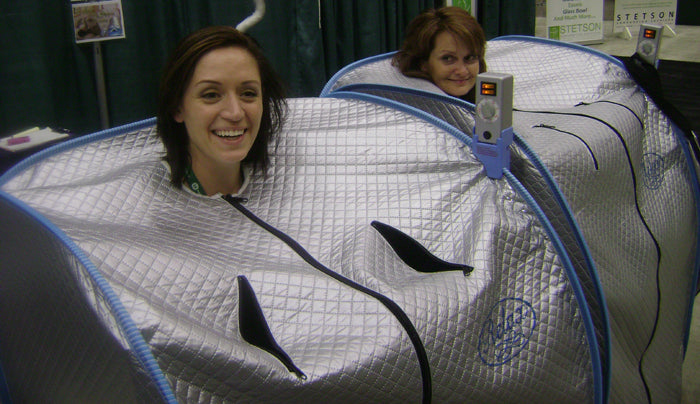
Both studies were small, single-center and supervised, one lacked a control group, and the controlled pilot did not report clear randomization. Waon is delivered at 60°C with the patient inside the cabin, followed by structured rest; head-out consumer cabins differ in temperature profile and in the air the patient breathes. No study has examined lung function decline, exacerbation frequency or mortality.
3. Mechanistic Rationale
FIR improves endothelial function and arterial stiffness through NRF2-associated cytoprotective pathways beyond the effect of equivalent heat (Bagabir et al. 2025), a mechanism relevant to the oxidative stress and pulmonary vascular dysfunction of COPD. Repeated Waon sessions shift autonomic balance toward parasympathetic predominance (Kuwahata et al. 2011), which may bear on dyspnea-related anxiety. These are mechanistic links, not demonstrated pulmonary outcomes.

4.1 Evidence Summary
4. Heat-Stress Risk
A meta-analysis of 25 observational studies found that extreme ambient heat increased COPD mortality (RR 1.19, 95% CI 1.09–1.30) and combined morbidity and mortality (RR 1.16) (Tran et al. 2025). Prolonged environmental heat differs from a brief controlled session, but the underlying vulnerabilities apply: increased ventilatory demand, dehydration, tachycardia, and vasodilation in patients with limited cardiopulmonary reserve. Patients with pulmonary hypertension or right heart failure are particularly sensitive to reductions in preload. In head-out cabins, inspired air remains at room temperature, which may reduce the respiratory burden compared with traditional saunas, though this has not been studied.
Long-term cohort data from traditional Finnish sauna use, which reported lower incident respiratory disease with frequent bathing (Kunutsor et al. 2017), involve a different modality and observational design and are excluded from the claims in this review.
4.1 Evidence Summary
| Study | Population / Model | Intervention | Key Finding | Tier |
|---|---|---|---|---|
| Umehara et al. 2008 | Severe COPD (GOLD), breathless despite therapy, n=13 | Waon: 15 min 60°C FIR sauna + 30 min blanket warming, daily × 4 wk | Exercise PA pressure 64→51 mmHg (p=0.028); RV dP/dt ↑; cycle time 360→392 s; SGRQ 59.7→55.3 (p=0.002); no adverse effects | Direct FIR, uncontrolled |
| Kikuchi et al. 2014 | COPD GOLD 1–4, n=20 | Waon 5×/wk × 20 sessions + usual care vs usual care, pilot controlled | FEF50 improved vs control (p=0.019); VC and PEF trends n.s.; no between-group 6MWT difference | Direct FIR, pilot controlled |
| Tran et al. 2025 | 25 observational studies | Extreme ambient heat | COPD mortality RR 1.19 (1.09–1.30); morbidity + mortality RR 1.16 | Meta-analysis (caution) |
| Bagabir et al. 2025 | Humans, heat-controlled RCT | FIR vs heat vs control | FIR improved endothelial function and arterial stiffness via NRF2-associated pathways beyond heat | Mechanistic (vascular) |
| Kuwahata et al. 2011 | CHF, n=54 | Waon daily × 4 wk | HF HRV power doubled; LF/HF 2.31→1.20 | Mechanistic (autonomic) |
| Kunutsor et al. 2017 | Finnish men, n=1,935, 25.6 yr | Traditional Finnish sauna frequency | Lower incident respiratory disease with ≥2 sessions/wk (HR 0.73; ≥4/wk HR 0.59) | Excluded from claims (different modality) |
| Home FIR sauna in COPD | — — | No controlled trial of home, head-out FIR sauna in COPD identified | No controlled trial of home, head-out FIR sauna in COPD identified | Not studied |
5. Explicit Positioning · What We Do Not Claim
- FIR does not treat COPD, reverse airflow limitation or slow disease progression.
- No study shows FIR improves FEV1 or reduces exacerbations, hospitalization or mortality.
- Waon data come from supervised 60°C hospital protocols in small samples and do not transfer directly to home use.
- FIR does not replace bronchodilators, oxygen, pulmonary rehabilitation or smoking cessation.
- Finnish sauna cohort findings are a different modality and are not cited as FIR evidence.
6. Open Question: What a Definitive Study Would Need
7. Clinical Guidance
Contraindications & Pitfalls
- Recommend sauna during or within weeks of an exacerbation, respiratory infection or hospitalization.
- Recommend sauna for patients with severe or unstable pulmonary hypertension, decompensated right or left heart failure, or resting hypoxemia without specialist input.
- Permit use of supplemental oxygen near heat sources without explicit guidance from the prescriber and equipment supplier on oxygen safety.
- Present FIR as a substitute for pulmonary rehabilitation or pharmacotherapy.
Supervised & Conservative Protocols
- For stable patients with physician approval, brief sessions (10–15 minutes) at a low setting on days at baseline, using head-out cabins.
- Pre- and post-session pulse oximetry and symptom checks, with the rescue inhaler within reach.
- Hydration before and after, and attention to diuretic use and orthostatic symptoms.
- Using the patient’s COPD action plan to define green, yellow and red days for session decisions.
- Positioning sauna as an adjunct to pulmonary rehabilitation, never a replacement.
8. Conclusion
Early Waon studies suggest that gentle, supervised FIR sauna may reduce exercise pulmonary pressure and improve exercise tolerance and quality of life in COPD, but the evidence consists of two small studies, one uncontrolled. Heat is also a recognized stressor for patients with limited cardiopulmonary reserve. Responsible positioning limits any home use to stable, physician-approved patients with conservative settings and safety monitoring, while a randomized trial alongside pulmonary rehabilitation is needed to define benefit.



Explore the Relax Far Infrared Line Up


Feel the Momentum