Depression & Heat: Promising
Depression & Heat: Promising
There's a real signal that heating the body can lift depression.
A sauna session isn't the experiment that found it.
If You're Struggling Right Now
If you're in crisis or thinking about harming yourself, call or text 988 (the US Suicide & Crisis Lifeline) or go to your nearest emergency room. Everything on this page is about a possible add-on for people who are already getting care — never a replacement for it.

The Honest Frame
Depression is treatable, and the strongest treatments — therapy, medication, and the plan you've built with your clinician — stay the plan. The question this page answers is narrower: is there anything to the idea that heat can help? The honest answer is yes, there's a genuinely interesting research signal, and there's a big catch about what "heat" meant in those studies.
What the Research Actually Shows
One Heating Session, a Real Difference in Depression Scores
One heating session, a real difference in depression scores. In a double-blind, sham-controlled trial, adults with major depressive disorder — medically healthy, and not taking psychiatric medication — received either a single session of whole-body hyperthermia or a sham session. The heated group had significantly lower Hamilton Depression Rating Scale scores than the sham group across the six-week follow-up (for example, a 6.5-point greater drop at week 1). The authors called it a promising, rapid-acting approach with mostly mild side effects (Janssen et al. 2016, JAMA Psychiatry).
The honest caveat: it's a small trial, and the blinding wasn't perfect — 94% of the heated group and 71% of the sham group believed they'd received real heating. Expectation can play a role in any depression study, so this is a signal worth following up, not a settled result.
The Follow-Up Study Couldn't Separate Heat from Everything Else
The follow-up study couldn't separate heat from everything else. A randomized pilot at UCSF gave 30 people with depression eight weekly sessions of cognitive behavioral therapy (CBT), plus four heating sessions — either real whole-body heating or a milder "sham" heating (Mason et al. 2025, Global Advances in Integrative Medicine and Health). Both groups improved dramatically — and the sham group's numbers were as good or better. The authors are direct about why that can't be read as "heat works": the pilot wasn't designed to compare the groups, there was no CBT-only group, the sham wasn't convincing (57% of the sham group thought they'd gotten the real thing), and the milder heat may itself have had an effect.
You may have seen headlines that around 90% of people in a UCSF infrared-sauna-plus-therapy program no longer met criteria for depression. That figure is real — it comes from an earlier study with no comparison group (Mason et al. 2024, Int J Hyperthermia) — and the later randomized pilot is exactly the reason to hold it loosely.
The Catch: This Wasn't a Typical Sauna Session
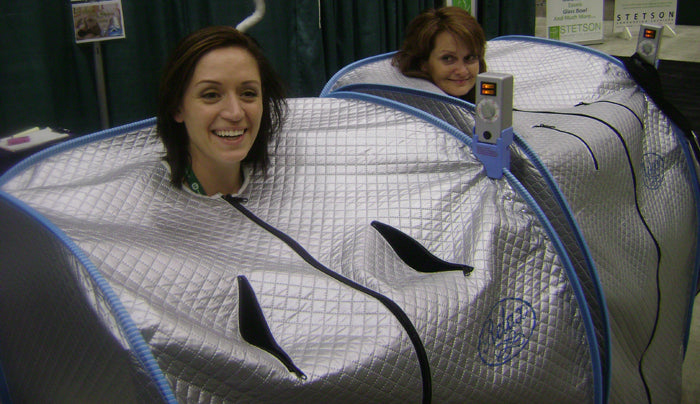
In the UCSF trial, participants were heated until their core body temperature — measured with a rectal probe — reached 38.5°C (101.3°F). In a far-infrared sauna dome, reaching that took about 98 minutes on average, with staff in the room, cool cloths on the head and neck, and fluids on hand. Not every session even reached the target.
That's a very different dose from a 15–20 minute home session. Nobody has tested a standard sauna session for depression, and no trial has used a Relax Sauna. Nothing here shows that a typical session does what those trials did.
Why might heat help at all? People with depression tend to run slightly warmer, and one leading hypothesis is that strong heating triggers a strong body-cooling response (sweating, blood-vessel dilation) that shifts the thermoregulatory circuits tied to mood. That's a hypothesis, not an established mechanism — and it doesn't tell us whether far infrared specifically matters or whether any strong heat would do.
What's Still Unknown
Still unknown: whether a standard far-infrared sauna session has any antidepressant effect; whether heat helps people who are already taking antidepressants (they were excluded from these trials); how long any benefit lasts; and whether it helps in bipolar depression or depression with psychotic features (not studied in these trials).

What We Can Honestly Say
If you already enjoy heat, a warm session may support relaxation and sleep — both worth having when you're depressed (see our companion Sleep and Stress & Mood pages). That's a reasonable, modest reason to use it. It's not a reason to expect a sauna to treat depression, and it's not a reason to change anything about your care.

Please Read Before You Try It
- This is not a treatment for depression and not a substitute for therapy, medication, or your clinician's plan. Please don't reduce or stop medication, or skip appointments, because of sauna use.
- Medications matter. The trials excluded people recently taking antidepressants, in part because these drugs affect temperature regulation and earlier work suggested smaller benefit. Some psychiatric medications (for example lithium, anticholinergic drugs, some antipsychotics, and some antidepressants) can change heat tolerance, sweating, or fluid balance. Ask your prescriber before using a sauna.
- Who was studied: adults with major depressive disorder without psychotic features. We found no trial in bipolar depression or psychosis, and pregnant people were excluded.
- Side effects at trial-level heat: headache was the most common (13 of 15 people in the heated group had at least one), followed by lightheadedness and nausea — mild, and mostly gone by the end of the day, with no serious events. Hydrate, and stop if you feel dizzy or unwell.
- If your depression is severe, or you're having thoughts of self-harm, please get care first — call or text 988, or contact your clinician.
For related mechanism and honest limits, see our companion Stress & Mood, Sleep, and HPA Axis pages.
Sources
Sources: Janssen et al. 2016 (JAMA Psychiatry 73(8):789-795; NCT01625546); Mason et al. 2025 (Glob Adv Integr Med Health 14:27536130251387714; NCT05708976); Mason et al. 2024 (Int J Hyperthermia 41(1):2351459).



Explore the Relax Far Infrared Line Up


Feel the Momentum