Relax Science Series - Red Light Vs. Real PBM
Red Light Bulbs Are Not Light Therapy
The Physics of Why a Tungsten Filament Bulb Cannot Deliver Photobiomodulation — And What Actually Can
1. Executive Overview
Walk into certain corners of the wellness internet and you’ll find a persistent claim: that a red-coated incandescent heat lamp — the kind you can buy at any hardware store for $8 — delivers “near-infrared therapy” equivalent to clinical photobiomodulation devices costing hundreds or thousands of dollars. The claim is fundamentally incorrect and violates basic principles of physics that can be verified from first principles.

2. A Tungsten Filament Bulb Is a Blackbody Radiator
Every tungsten filament incandescent bulb operates on the same physical principle: electrical current heats a tungsten wire to approximately 2,500–3,000 Kelvin, and the wire radiates electromagnetic energy according to Planck’s law of blackbody radiation. A heated solid object emits a continuous, predictable spectrum determined entirely by its temperature. At an operating temperature of 2,800 K, Wien’s displacement law places peak emission at approximately 1,035 nm in the mid-infrared:
- Infrared Output: Approximately 85–88% of total radiated energy falls in the infrared region above 700 nm, dominated by mid-infrared wavelengths that produce broadband thermal heating without photobiomodulation activity.
- Visible & UV Output: Only 12–15% falls in the visible spectrum (400–700 nm), and less than 1% falls in the ultraviolet range.
- Therapeutic Window: Only 5–10% of total output falls within the therapeutic near-infrared window (600–900 nm), spread across a continuous band rather than concentrated at specific wavelengths.
- The Red Coating Effect: A red coating acts merely as a cosmetic filter that selectively blocks shorter visible wavelengths to appear red, while the filament itself continues to emit the exact same broadband spectrum.
3. What Photobiomodulation Actually Requires
Photobiomodulation (PBM) is a precise photochemical process requiring specific parameters to be met simultaneously:
- Wavelength Specificity: Operates between 600 and 1,000 nm targeting cytochrome c oxidase (CCO), with peaks at 660 nm (red) for superficial tissues and 810–850 nm (near-infrared) for deeper targets.
- Power Density (Irradiance): Requires 5 mW/cm² to 5 W/cm² at the tissue surface to deliver sufficient photon flux, whereas unmeasured tungsten bulbs fall far below this clinical threshold.
- Energy Dose (Fluence): Clinical protocols specify 1–50 J/cm² depending on the target tissue, which requires dosimetric control entirely absent in thermal bulbs.
- Tissue Penetration: Red light penetrates 2–3 mm, and NIR reaches 5–10 mm, whereas a tungsten bulb's peak emission at 1,035 nm is absorbed by water in surface tissue layers as heat.
4. Parameter Comparison
| Parameter | Red Tungsten Bulb | Clinical PBM Device |
|---|---|---|
| Source Type | Blackbody thermal radiator | LED or laser diode |
| Emission Spectrum | Continuous broadband (visible through mid-IR) | Narrow-band: 660, 810, 830, or 850 nm |
| Peak Emission | ~1,035 nm (mid-infrared) | Matched to CCO absorption peaks |
| Therapeutic Window Output | 5–10% (600–900 nm) | 95–100% at target wavelength |
| Chromophore Activation | Negligible CCO interaction | Direct CCO photoexcitation |
| Power Density | Below clinical threshold | 5 mW/cm² to 5 W/cm² (specified) |
| Energy Dose Control | None — unmeasured, uncontrolled | Precise: 1–50 J/cm² (prescribed) |
| Mechanism | Primarily thermal (broadband heat) | Primarily photochemical (CCO activation) |
5. The Difference Between Warming and Healing
While a red heat lamp feels warm and promotes localized vasodilation, thermotherapy is categorically different from photobiomodulation:
- Thermotherapy: Raises tissue temperature through broadband infrared absorption independently of wavelength, achievable with any heat source.
- Photobiomodulation: Delivers specific photon energies to cytochrome c oxidase, triggering ATP synthesis, mitochondrial signaling, and anti-inflammatory gene expression.
6. Choosing Evidence-Based Light Therapy
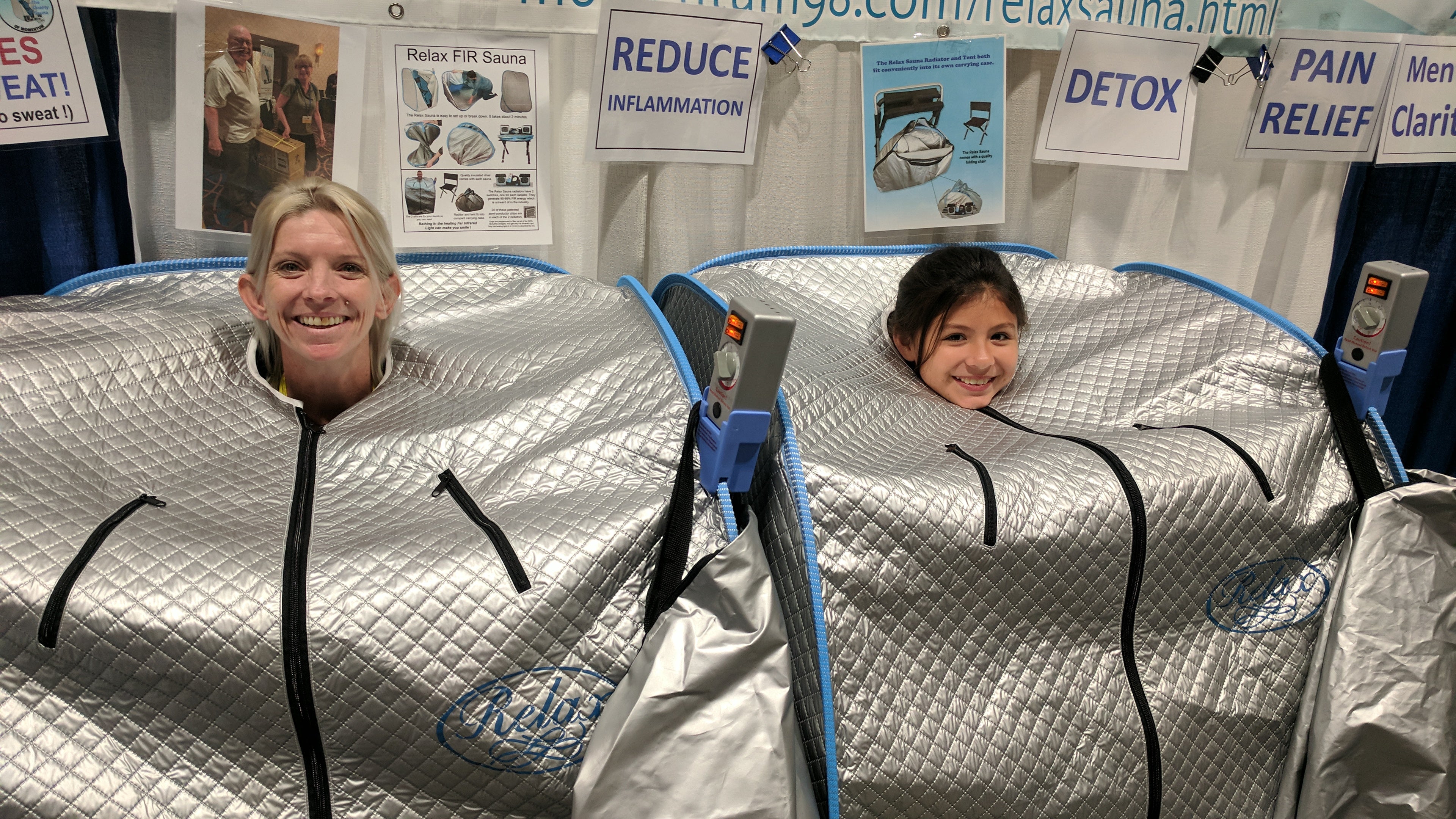
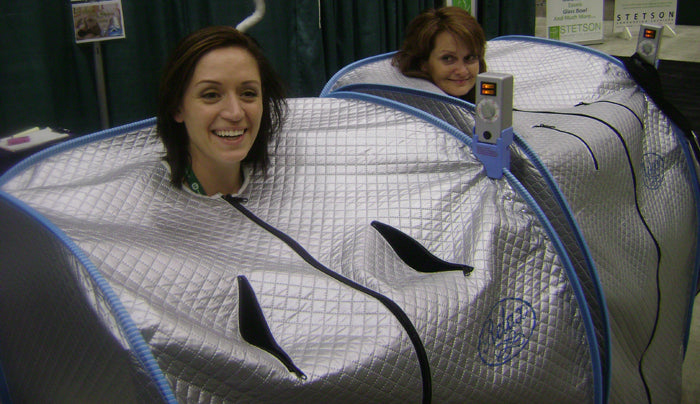
Genuine photobiomodulation requires medical-grade LEDs or laser diodes with narrow spectral output (±10 nm) at 660 nm and/or 810–850 nm. Furthermore, far-infrared sauna therapy (such as the Relax Sauna operating in the 4–14 micron range) utilizes semiconductor-based FIR generation for resonant water molecule absorption, which is completely distinct from a tungsten heat lamp.
The Bottom Line
A red tungsten bulb is not a photobiomodulation device. It is a broadband heat source with a colored coating. Real therapeutic light requires real engineering.
Download the Full Document


Explore the Relax Far Infrared Line Up


Feel the Momentum