Far Infrared, Passive Heating, and Insomnia / Sleep Disturbance
Water-Based Heating Evidence, Small and Mixed FIR Textile Trials, and an Absent Evidence Base for FIR Sauna
Overview
Chronic insomnia disorder affects roughly 10% of adults, and cognitive behavioral therapy for insomnia (CBT-I) is the guideline-recommended first-line treatment.
Against that standard, the heat-and-sleep literature has three distinct parts: a meta-analysis supporting pre-bedtime water-based passive body heating (not FIR); a small number of pilot trials of FIR-emitting textiles with mixed results; and an absent evidence base for FIR sauna sessions as an insomnia intervention.
No trial identified enrolled patients with a diagnosed insomnia disorder. This review covers insomnia and general sleep disturbance only and does not review sleep apnea, restless legs syndrome, circadian rhythm disorders, or other sleep disorders.
Absence of identified studies reflects the searches conducted here, not a systematic review.
Treatment Context: CBT-I as First-Line
The American College of Physicians recommends that all adult patients receive CBT-I as the initial treatment for chronic insomnia disorder (strong recommendation, moderate-quality evidence) and that clinicians weigh benefits, harms, and costs before adding short-term pharmacotherapy in patients for whom CBT-I alone was unsuccessful (weak recommendation, low-quality evidence) (Qaseem et al., Ann Intern Med 2016;165(2):125–133).
The ACP release notes that sleep medications can be associated with serious adverse effects. The American Academy of Sleep Medicine pharmacologic guideline likewise states that CBT-I is a standard of treatment with a favorable benefit-risk ratio and that all patients with chronic insomnia should receive it as a primary intervention (AASM Clinical Practice Guideline, PMC5263087).
CBT-I combines cognitive therapy about sleep with behavioral components such as sleep restriction and stimulus control, and remission occurs in roughly two-thirds of patients; online delivery expands access, and sleep restriction may exacerbate daytime somnolence in patients with obstructive sleep apnea (Editorial, PMC12713853).
Any heat-based adjunct is therefore positioned against an established, guideline-level behavioral treatment and must not displace it or delay evaluation for comorbid sleep-disordered breathing.
Passive Body Heating Evidence
Water-Based, Not FIRA systematic review and meta-analysis of before-bedtime water-based passive body heating found that warm baths or showers at 40–42.5°C were associated with improved self-rated sleep quality and sleep efficiency, and that when scheduled 1–2 hours before bedtime for as little as 10 minutes, sleep onset latency was significantly shortened (about 10 minutes on average in secondary reports), most likely by enhancing the decline in core body temperature before sleep ( Haghayegh et al., Sleep Med Rev 2019;46:124–135, doi:10.1016/j.smrv.2019.04.008 ).
The authors acknowledge disparities across studies: many investigations demonstrate improvement in sleep parameters while some do not. The mechanism proposed is peripheral vasodilation with increased heat dissipation, producing the core temperature decline that accompanies sleep onset.
Three limitations apply to FIR: the intervention was water-based, the timing window (1–2 hours before bed) was specified, and the evidence does not address radiant FIR sessions, higher thermal loads, or sauna exposure.
Heat applied close to bedtime may oppose the core-temperature decline that the timing window is thought to exploit; optimal timing for FIR has not been studied.
FIR-Specific Evidence: Textile Trials
Bedsheets
A pilot randomized trial by McCall and colleagues, as described in the introduction of a later trial, reported that 29 healthy adults sleeping on FIR bio-ceramic bedsheets had fewer reported insomnia symptoms than on placebo sheets (as cited in Chen et al. 2023).
We reviewed this study only through that secondary description. The population was healthy adults, not patients with insomnia.
Pajamas
In a pilot randomized, parallel-group, double-blind, sham-controlled trial, 40 adults with poor sleep quality (PSQI at least 5) were randomized 1:1 to FIR-emitting or sham pajamas, with PSQI as the primary outcome at weeks 2, 4, and 6.
Both groups improved within group, but there was no significant between-group difference on PSQI or other sleep measures, and the sham group showed a non-significant trend toward greater PSQI reductions with small effect sizes (week 2, d = 0.393, p = 0.112; week 4, d = 0.328, p = 0.273).
A secondary physical-fatigue measure (MFI-physical) favored the FIR pajamas, which the authors identify as warranting further exploration; the pajamas were generally safe ( Chen SC et al., Int J Environ Res Public Health 2023;20(5):3870 ).
The authors attribute improvements in the sham group to various factors, consistent with expectancy and other non-specific effects.
Blanket
A double-blind randomized study in 24 men aged over 45 years (12 per group) tested the DAZZEON αSleep far-infrared blanket for 14 consecutive days.
Only the FIR group showed a significant reduction in PSQI relative to its own baseline (p<0.001); REM and REM-plus-deep sleep time estimated by a consumer wearable (Xiaomi Mi Band) increased pre-to-post only in the FIR group; blood serotonin, melatonin, and nitric oxide were reported higher than placebo; and no significant differences in total sleep time were observed between groups.
The authors note that the wearable estimates sleep stages from heart rhythm and activity rather than measuring them directly, and that physiological changes may not necessarily translate into subjective perceptions of improved sleep (Clocks Sleep 2024;6(3):33, PMC11417803).
Sample size, sex, wearable-based staging, and the reliance on within-group comparisons for the PSQI result limit interpretation.
FIR Sauna
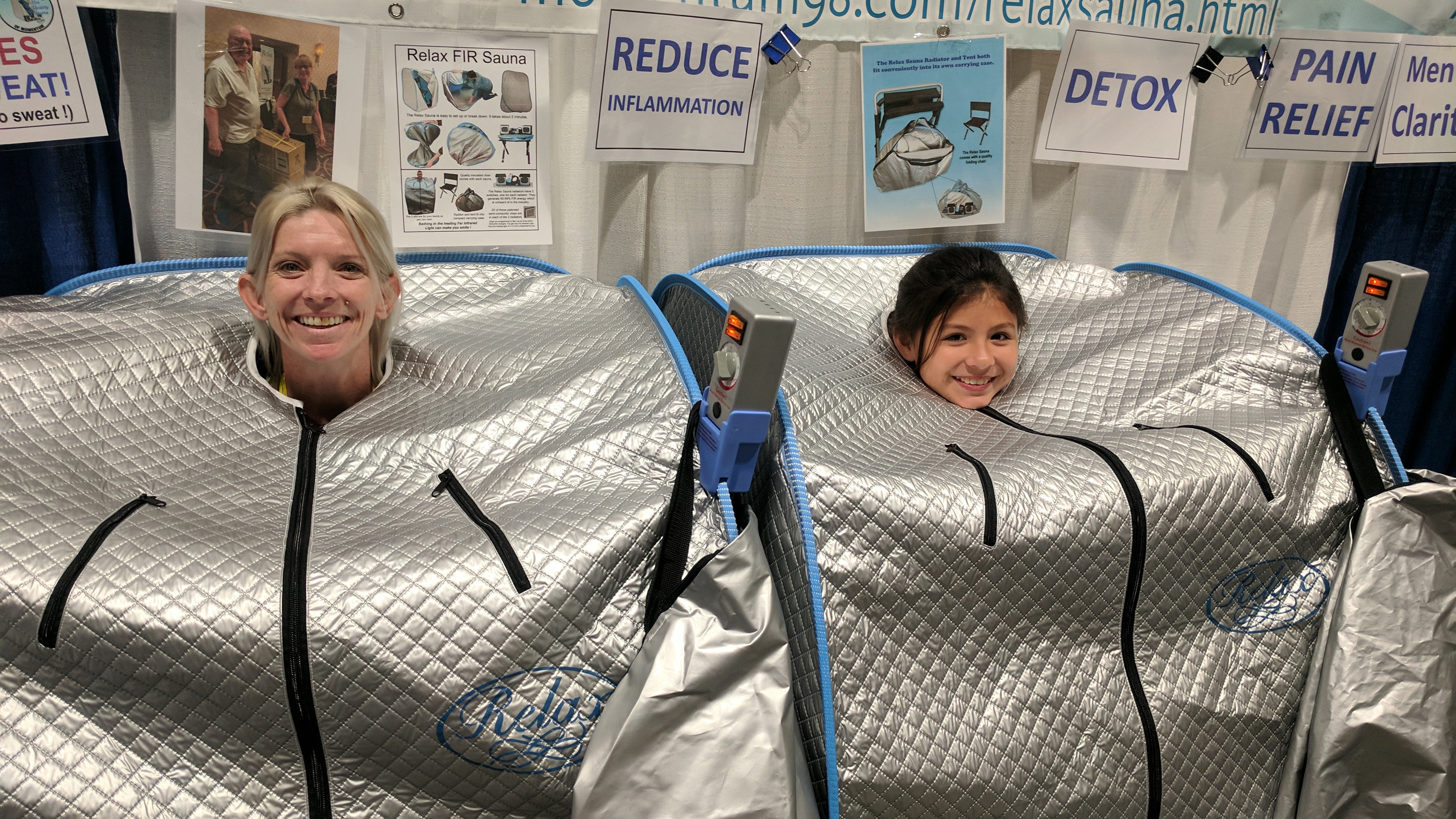
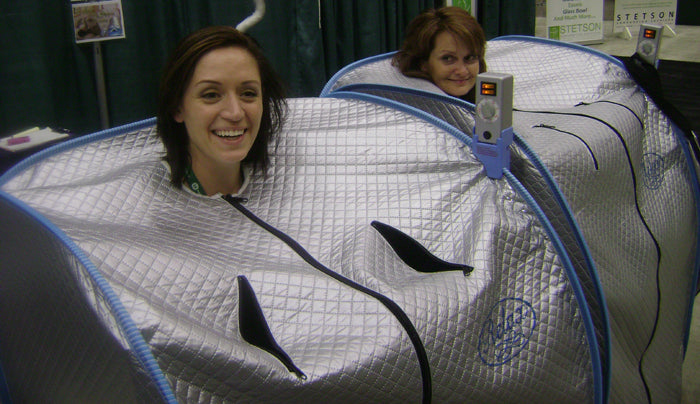
We did not identify a trial of FIR sauna sessions for insomnia or sleep disturbance.
A randomized, unmasked, parallel-group trial of evening sauna bathing (nine sessions over three weeks) in healthy participants with sleep radar, sleep diary, mood, and stress outcomes is registered (NCT06125639); we did not identify results.
Sauna modality, dose, and timing cannot be inferred from the water-based or textile literature.
Mechanistic Rationale — Transferred, Not Direct
The leading rationale is thermoregulatory: passive warming increases distal vasodilation and subsequent core cooling, which is associated with sleep onset.
FIR textiles are proposed to create a comfortable thermal environment, which one trial group links to better sleep quality. Serotonin, melatonin, and nitric oxide changes reported with the blanket are small-sample findings.
None of these mechanisms has been tested in patients with insomnia disorder, and the heat-matched comparison needed to separate FIR from ordinary warmth has not been performed for sleep outcomes.
Correcting Circulating Claims — Practitioner Advisory
What Patients May Bring
- Percentages attributed to FIR bedding (for example, a roughly 42% reduction in sleep-quality score) derive from a 24-person study and reflect change from the group's own baseline, with no between-group difference in total sleep time. They should not be represented as expected effects.
- Wellness content presenting infrared sauna as a treatment for insomnia. We identified no trial of FIR sauna for sleep; the warm-bath meta-analysis uses water-based heating at specified temperatures and timing.
- The sham-controlled pajama trial found no between-group sleep benefit. Within-group improvements in FIR arms should be interpreted alongside improvements in sham arms.
Safety Considerations
Clinical Cautions
- Evaluate before adjuncts: persistent insomnia warrants assessment for sleep-disordered breathing, mood and anxiety disorders, medication effects, and other contributors; heat should not delay CBT-I or diagnosis.
- Timing: evidence for pre-bed warming specifies completion 1–2 hours before bedtime; heat closer to sleep may oppose core cooling. No timing data exist for FIR.
- Sedatives and alcohol: combining heat with alcohol, hypnotics, or other sedating agents raises concerns for hypotension, dizziness, dehydration, and falls; review with the prescriber. The ACP notes serious adverse effects can accompany sleep medications.
- Orthostatic symptoms and nocturnal falls: evening sessions in patients who are already drowsy warrant slow rising and supervision where indicated.
- Cardiovascular, conduction, and pregnancy considerations in companion reviews apply to individual patients.
- Mood: insomnia commonly accompanies depression and anxiety; suicidality warrants standard assessment and crisis resources (in the US, call or text 988) before any adjunct discussion.
- No claim in this document should be represented to patients as evidence that FIR treats insomnia or improves sleep disorders.
Evidence Grading Summary
| Domain | Model / Design | Finding | Tier |
|---|---|---|---|
| CBT-I, chronic insomnia (context) | ACP guideline; AASM guideline | First-line; strong recommendation, moderate-quality evidence | Established Treatment (Not FIR) |
| Warm water 1–2 h before bed | Systematic review / meta-analysis | Sleep quality, efficiency, and onset latency improved; heterogeneity noted | Direct, Different Modality |
| FIR bedsheets, healthy adults | Pilot RCT, n=29 (secondary description) | Fewer reported insomnia symptoms vs placebo sheets | Preliminary |
| FIR pajamas, poor sleepers | Sham-controlled pilot RCT, n=40 | No significant between-group difference on PSQI; fatigue measure favored FIR | Direct, Null Primary Outcome |
| FIR blanket, men >45 | Double-blind RCT, n=24, 14 days | Within-group PSQI gain; no total sleep time difference; wearable staging | Preliminary, Small |
| FIR sauna sessions for insomnia | N/A | No trial identified; healthy-volunteer sauna trial registered, results not located | Absent |
| FIR timing relative to bedtime | N/A | No data | Absent |
On smaller screens, swipe horizontally to view the full table.
Clinical Positioning
FIR sauna and FIR devices should not be presented as a treatment for insomnia.
For patients who ask, the useful message is that CBT-I is the first-line treatment, that warmth completed 1–2 hours before bed has meta-analytic support in water-based form, that FIR textile trials are small and mixed with a null primary result in the sham-controlled trial, and that FIR timing and dose for sleep are unstudied.
Any use should be framed as a supervised comfort choice scheduled earlier in the evening and stopped if it produces arousal or discomfort.
References
- Haghayegh S, Khoshnevis S, Smolensky MH, Diller KR, Castriotta RJ. Before-bedtime passive body heating by warm shower or bath to improve sleep: a systematic review and meta-analysis. Sleep Med Rev. 2019;46:124–135. View study ↗
- Chen SC, Cheung TW, Yu BYM, Chan MY, Yeung WF, Li L. Improving Sleep with Far-Infrared-Emitting Pajamas: A Pilot Randomized Controlled Trial. Int J Environ Res Public Health. 2023;20(5):3870. View study ↗
- The Impact of DAZZEON αSleep Far-Infrared Blanket on Sleep, Blood Pressure, Vascular Health, Muscle Function, Inflammation, and Fatigue. Clocks Sleep. 2024;6(3):33. PMC11417803. View study ↗
- McCall et al. Pilot randomized trial of FIR bio-ceramic bedsheets on insomnia symptoms in healthy adults. As cited in Chen et al. 2023.
- Qaseem A, Kansagara D, Forciea MA, Cooke M, Denberg TD. Management of chronic insomnia disorder in adults: a clinical practice guideline from the American College of Physicians. Ann Intern Med. 2016;165(2):125–133. View guideline ↗
- Clinical Practice Guideline for the Pharmacologic Treatment of Chronic Insomnia in Adults: An American Academy of Sleep Medicine Clinical Practice Guideline. PMC5263087. View guideline ↗
- Editorial: Online cognitive behavioral therapy for insomnia. PMC12713853. View editorial ↗
- Effects of Sauna Bathing on Sleep, Mood and Stress. ClinicalTrials.gov NCT06125639. View trial registration ↗